From Medium

The End of Empathy?

Elephants are considered to be one of the most empathic species in the world. Maybe we should learn a little from them. Image by Dan Sudermann from Pixabay

I have been feeling some kind of way lately, and I decided to write about it.

I’ve been writing this essay, in fits and starts, since Renée Good was murdered by an ICE agent in Minneapolis. I was still writing it when Alex Pretti was murdered by two different ICE agents in Minneapolis while several others acted as accomplices.

Yes. Murdered. I’m not going to equivocate on that.

Good was a mother. A poet. She may or may not have been a legal observer. She was definitely a US citizen.

She was shot three times. At least once in the face. At point-blank range.

We’ve also learned that Good did not die immediately from her wounds. That she still had a pulse when ICE agents prevented a physician from checking on her.

Pretti was an ICU nurse at a VA hospital—an employee of the federal government. He was a licensed gun owner. He was trying to help a woman who had been thrown to the ground by an ICE agent.

He was pepper sprayed, then shot at least ten times. Six of those shots were fired after he already laid motionless on the ground.

Normally, something of this length would take me a few hours to write. But I spent weeks on this essay, largely because bad shit that I felt compelled to include just kept happening. But ultimately, I decided the piece was getting too long and it was time to edit and publish.

You can read the whole piece here. I hope the next thing I write will be lighter.
From Medium

The Very Real, Totally Hidden, Costs of Being an Adult With ADHD

A person wearing a blue shirt holds several hundred dollar bills in a fan shape, covering her face. The bills have been lit on fire.

As an adult, getting diagnosed with ADHD is both time consuming and costly. Trying to get your meds filled, while not costly, will take hours of your life during which you’d rather be doing literally anything else. But what nobody talks about is how much things start to cost you because you have ADHD, outside of the actual medical costs of having ADHD.

So now I’m talking about it:

If you are a person with ADHD who struggles sometimes to remember to do something that is ostensibly simple, or who gets so distracted during the process of doing it that the task is never completed, companies … are counting on people like you to miss your to chance to save your money or get your money back. That way, they can keep more of it for themselves.

The costs people with ADHD do not talk about—whether because they don’t realize these are associated costs or because they do but they’re embarrassed by them—are the ones that can’t be tied directly to treating or managing their condition. They don’t talk about how they bought the same book three times because they couldn’t remember whether they owned it or not. About how they keep throwing expired yogurt away because it had been languishing for months in the back of the fridge, where they’d forgotten they’d placed it because they were on the phone with their parents when they unloaded their groceries and weren’t paying attention to what went where. About how they have now bought at least five travel pillows from various airports because they couldn’t be bothered to make a packing list and they left their other pillows at home. (Are these also examples taken from my own life? I think you already know the answer.)

Read my latest essay on Medium here.

From Medium

This New Year, Instead of Resolutions, Set Intentions

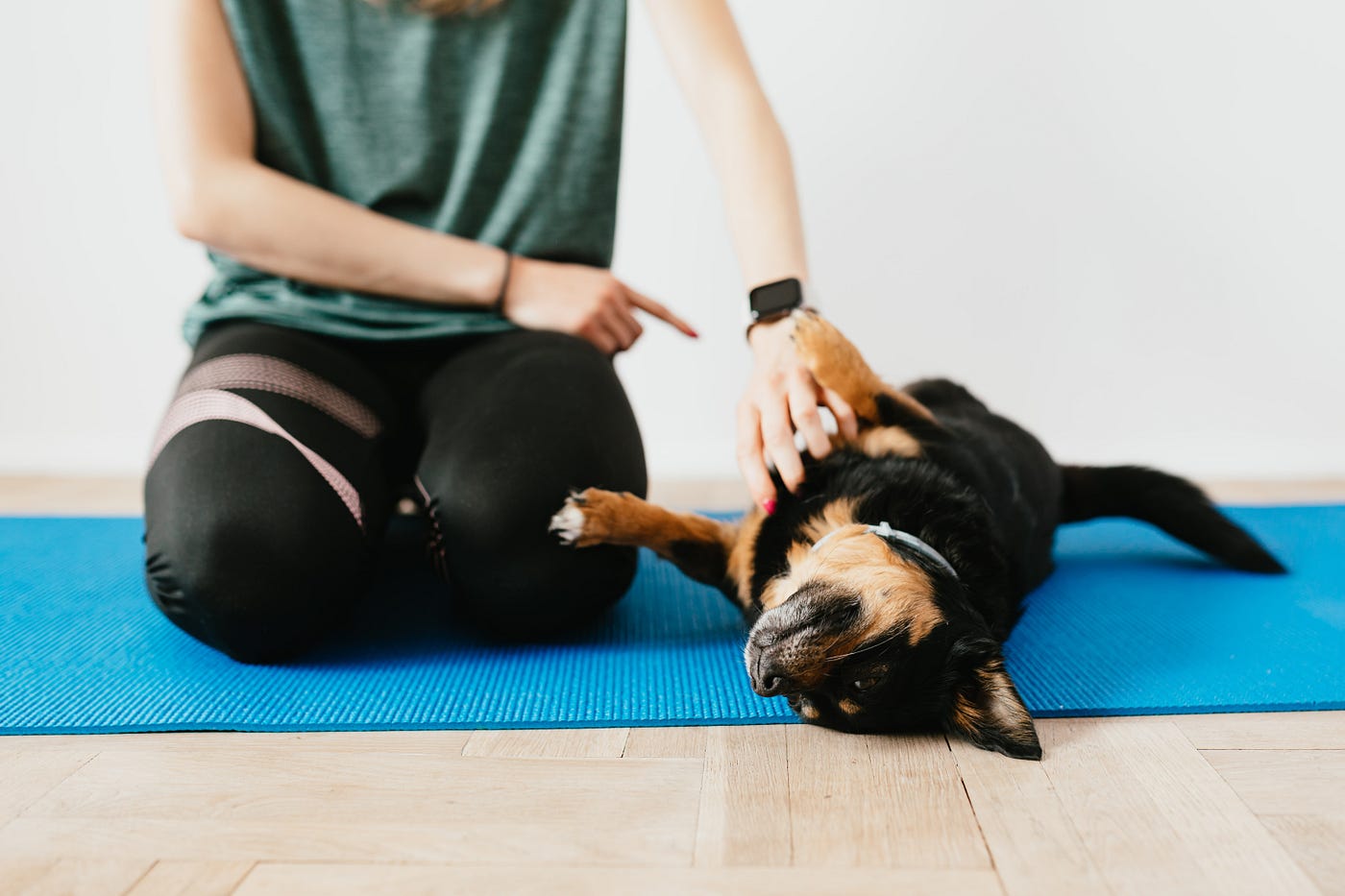
A black-and-tan dog lies on its belly on a blue yoga mat. Beside the dog, a person uses one hand to administer belly rubs while using the other to gently scold the dog for interrupting their practice.

Let’s hear it for the kind of intense, hypercompetitive type-A personalities who beat themselves up every February because they’ve “failed” their New Year’s resolutions. I know their pain so well.

A few years ago, I started setting intentions instead of making resolutions. It’s a practice that’s been very much informed by my practice as a yoga student and teacher, and it’s honestly been life-changing. More on Medium.

When I tell my students to reframe their resolutions as intentions, what I’m really telling them to give themselves permission to fail. So what if they said they were going to come to yoga four times a week and they only averaged two? So what if they started taking streaming classes rather than going to the studio because it was challenging for them to make it there on time? So what if half the time they were streaming those classes they were also distracted by their kids or their dogs or the jackhammering down the block? So what if they logged off before savasana because they had to focus on something else?

These are not the sort of things you’re supposed to beat yourself up about. But people do.

From Medium

It’s Time To Rethink “Professionalism”

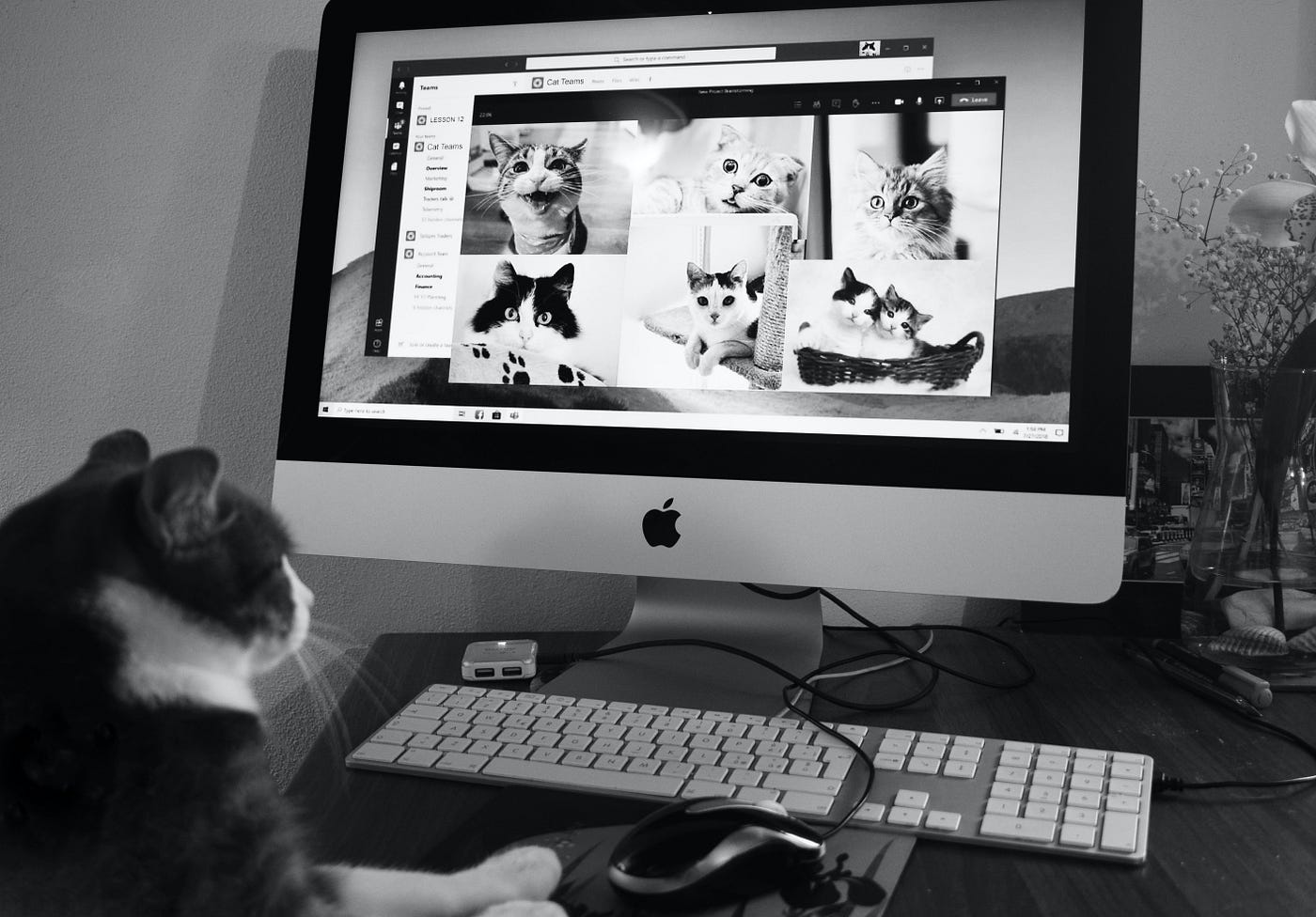
A black and white photo of a tuxedo cat sitting at a desktop computer. The cat appears to be on Zoom with six other cats.

I’ve been working from home since well before the pandemic and I’ve done just fine, thank you very much. Still, there are those who are concerned workers can’t get their jobs done if they’re not wearing business casual attire and sitting at their computers from exactly 9 a.m. to 5 p.m.

I call BS. We’ve been videoconferencing for more than a year now, literally seeing inside of our colleagues’ homes. It’s time that companies start to see the workers who keep their lights on as people, not just employees.

Below excerpt is from my latest piece on Medium and it is blowing up. Guess it resonates! Read the whole thing here.

Decades of workplace culture have indoctrinated us with a very specific idea of what “professionalism” is. The 9–5 schedule, the dress code, the endless meetings (and meetings about meetings), and the belief that even though laptop computers and at-home high-speed internet exist, you could really only do your job at the office, no matter how long or miserable or sometimes downright dangerous your commute.…

If there is one thing the pandemic has taught us, though, it’s that literally none of those rules of workplace professionalism matter. Professionalism in 2021 isn’t about what time you show up for work or whether your interpretation of “business casual” is consistent with your company’s policy. None of that matters. None of it ever actually mattered; we just collectively convinced ourselves over the years that it did.

From Medium

“It occurs to me that I am America.”

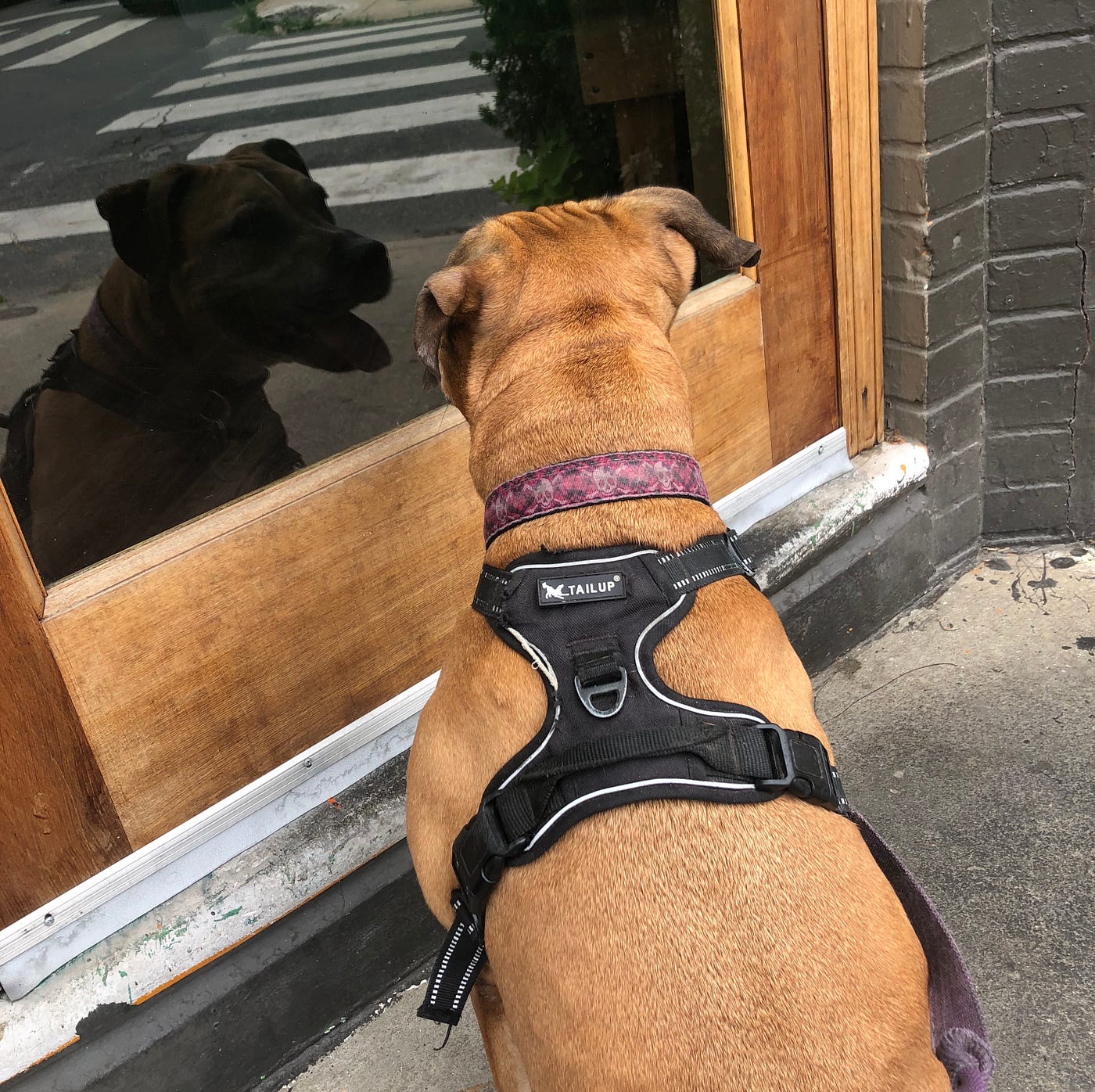
Gracie, a reddish-brown pit bull wearing a pink collar and black harness, stares at her reflection in a shop window.

It’s the Fourth of July. It’s still a pandemic. We’re entering the second month of Black Lives Matter protests. And it’s hard not to have some big, conflicting feelings, about it all:

Everywhere you look, you see America failing.

America is failing to protect its citizens from disease. Failing to protect them from racism. Failing to protect them from an increasingly militarized police. Failing to protect the enlisted amongst them from a hostile nation that has tried every way it can to destabilize our government, our economy, our society.

This one originally went out in Puppies & Politics, but I posted it on Medium, too. If you aren’t a P&P subscriber (why aren’t you a P&P subscriber?) click here. Read the full essay in the archive on the subscription page, or click here to view it on Medium.

From Medium

The Pervasiveness of Abusive Men

MeToo
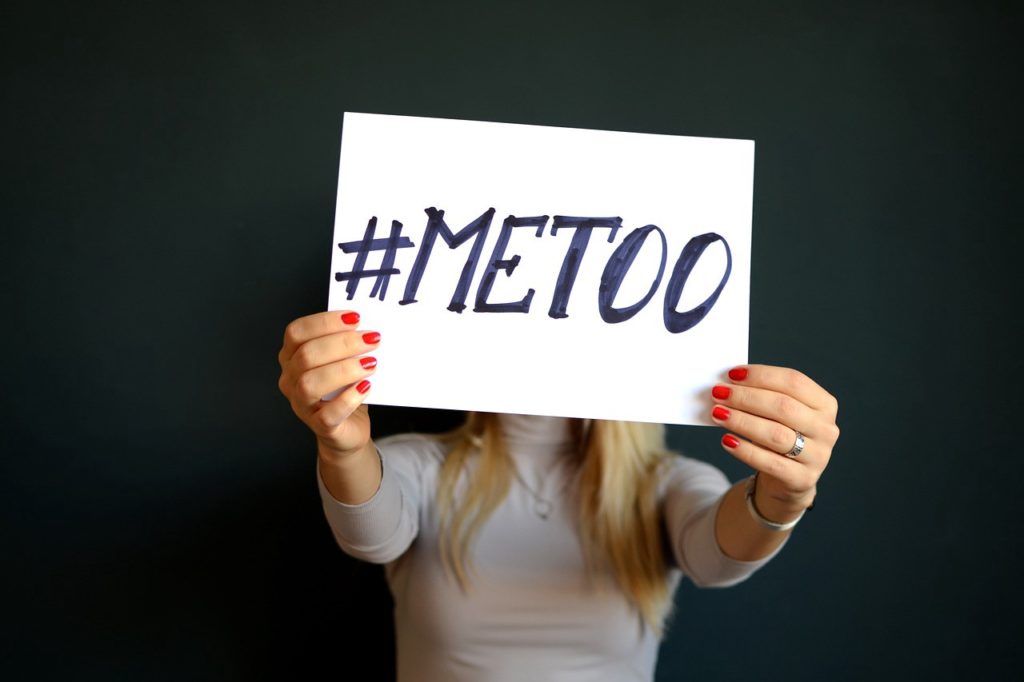
Photo: surdumihail on Pixabay. (Image description: a blonde woman holds a handwritten white sign reading “#METOO” is in front of her face. She has red fingernails.)

I’m feeling some kind of way about Brett Kavanaugh. From Medium:

We cannot escape this crap. Men who have done shitty things to women are everywhere. They are on TV and in movies and making music and writing books. They are getting away with it, or at the very least, being offered redemption arcs so condensed they’d make a soap opera writer’s head spin.

Read the whole post here. Especially if you’re angry like I am.

From Medium

What We Talk About When We Talk About Mansplaining

Photo by rawpixel on Unsplash. (Image description: A woman sits at a conference table while a man leans over her, pointing to her laptop. The woman does not look amused.)

I liked this week’s newsletter so much that I put it up on Medium, too. It was inspired by a tense conversation in a private group I’m in, and I couldn’t not take it on at more length when I had time to write about it:

Earlier this week […] I found myself having to clarify — not for the first time, either — that yes, mansplaining is a real thing and no, we can’t just write it off to someone being an asshole, and yes, lots of people “-splain” but no, that doesn’t mean mansplaining isn’t its own, specific thing. Over the course of the conversation, this flowchart was brought up, first as an explainer of mansplaining and then with the argument “but anyone can be guilty of doing this,” which is a fair point. Yes, the chart outlines behavior that’s rude and condescending regardless of who it’s coming from. What’s missing is an initial question: would you feel compelled to offer this explanation if you were talking to a man?

Want to read the rest? You’ll find it here.

From Medium

Stop Asking People for Free Work

I get approached a lot by people who want me to help them do something, but they don’t see why they should pay for it—and I’m not alone.

I can’t tell you the number of times while pitching work and applying for jobs that I’ve been asked to create a marketing plan, or to write a piece of thought leadership, or to conduct a comprehensive edit of existing materials, for free. Not only is this exactly the kind of work I charge clients for, but if I agree to do it, I’m also taking time away from that paying client work. If I had agreed to write this marketing plan, it would have taken about four hours of my time; they would have wound up with a functional marketing plan, and I would have wound up four hours of billable time in the hole.

Want to learn how you can do better? See the full piece on Medium.

From Medium

Your Cheap Overseas Social Media Team Is Awfully Expensive

There are a lot of ways to be bad at social media, but I was recently exposed to one of the worst examples I’ve seen:

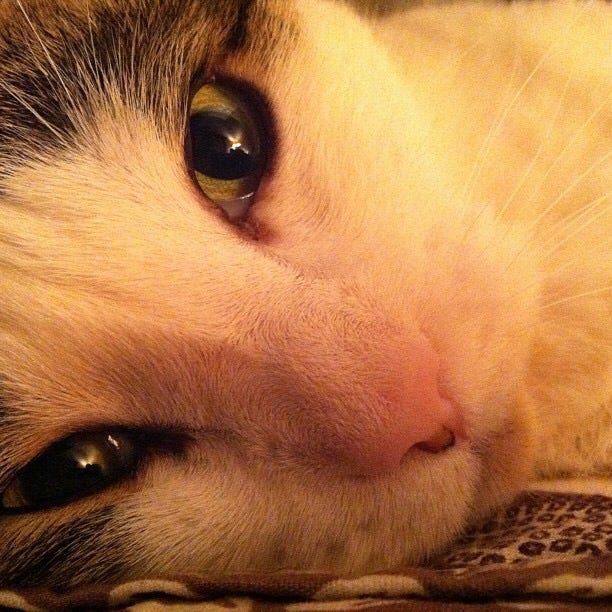
After a brief illness that I wrote about here, my cat Simon (pictured above) died in bed with my husband and me this Monday morning. It sucked. It really, really sucked. But what sucked even more was looking at my phone that afternoon and seeing that, in response to my Instagram post about saying goodbye to Simon, the Philadelphia Injury Lawyers left this comment:

The saga continues on Medium.
From Medium

Schrödinger’s Cat

Simon came home from the hospital with a cancer diagnosis and an upper respiratory infection, and we had to keep him isolated from the rest of the cats until the later was no longer infectious. I spent a lot of time thinking about the paradox of Schrödinger’s Cat while Simon was in isolation, always wondering what would await me when I opened the door to his quarantine area:

The bathroom in which Simon currently resides is at the top of the stairs, so I pass it several times daily. Sometimes I continue with whatever I was doing the had me going up or down the stairs in the first place. Sometimes I come in and sit with him for a few minutes, like I’m doing now. Most times, though, I stand in front of the door, debating whether to open it.

More reflections on slowly losing a beloved pet are on Medium.